Rewriting Heroes and Villains
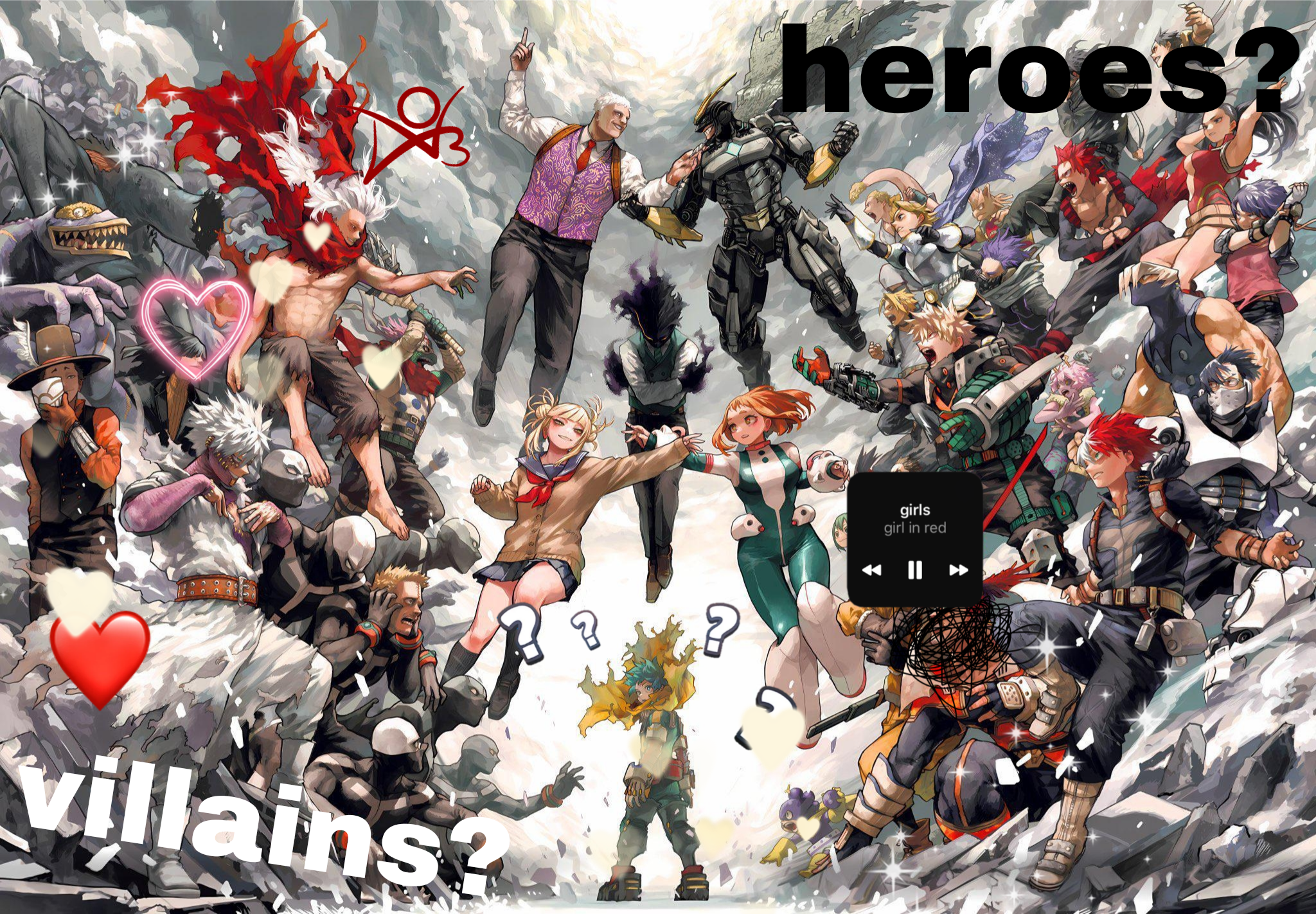
Fans have always had to build their own spaces when the ones they relied on failed them (Fiesler, 2018). In my last post The Internet Isn’t Designed for You (Yet) I talked about how AO3 was created because previous sites kept deleting, censoring, and judging fanworks. The basic idea was that if fans don’t control the space, they can’t control what happens to the things they make in it. Of course, fanworks have been transforming source material since long before AO3, the site just gave them a stable place to keep doing what they’d always done. Beyond that, the platform design made it easier for readers to connect otherwise unrelated fics through tagged pairings, tropes, themes, etc (Silberstein-Bamford, 2024). My Hero Academia is a good example of how this plays out. The fandom is loud, borderline obnoxious at times, and full of competing interpretations ranging from thoughtful to downright unhinged. The source material itself is fairly easy to pull apart. The world is built around a professional super hero system, where people with strong “quirks” or powers become professional heroes who are supposed to keep society safe from “villains” (Horikoshi, 2024).
The main character, Izuku Midoriya, starts off with no quirk at all, but inherits one alongside a massive legacy from the number 1 hero All Might and enters UA High School to train as a hero. As is common in superhero media (e.g. X-Men, Superman) superpowers in this world provide an interesting allegory for real life marginalization, where someone's quirk status determines their place in society. Mutants are ostracized for their appearances, dangerous quirks are labeled villainous, some individuals are victims of human trafficking for their quirks, and the quirkless don’t belong at all (Horikoshi, 2024). It’s a very interesting setup and makes a lot of space for fans to analyze and reinterpret what’s happening, AO3’s design then makes those interpretations easy to track. Tags and categories let readers navigate the specific issues a story addresses, and the “inspired by” field shows exactly which works influenced which, making it easy to see when a story is building off someone else’s (Silberstein-Bamford, 2024).

Because of this, fandoms like MHA's often create overlapping readings of the same material. Some writers focus on institutional critique, others on character psychology, some on interpersonal relationships or something else entirely. For Izuku in particular, many interpretations cluster around his lack of a quirk, his marginalization from hero society, and what solutions make sense in face of systemic issues. AO3 turns these isolated fan ideas into visible, traceable patterns—basically, communities forming around shared ways of reading the story. Fan scholar Kristina Busse refers to this as an “interpretive community” in action (Busse, 2017).
The lineage of fanfictions I will discuss today, starting with (How To) Forgive and Forget (HTFAF) and continuing through Tea in a bar and Lost and Found, show how interpretive communities work in fandom and what they have to say. In this example, the community's interpretation is focused on the systemic failings of hero society in MHA canon, highlighting issues like marginalization, quirk abuse, and institutional neglect as central to the protagonist's trauma. The fics all agree that established institutions, like UA High School and the Hero Public Safety Commission (HPSC), are deeply flawed and corrupt. The first work, How to forgive and forget by legal kidnapping, is a foundational story that created the pillars of this community, specifically Izuku Midoriya's rejection of the hero system and his discovery of emotional safety and companionship with the League of Villains (LOV). The following two fics explicitly draw inspiration from HTFAF, and expand upon this shared reading. All three stories agree on Izuku’s burnout, trauma, and the system's failure, but where they disagree is on the solution.
(How To) Forgive and Forget establishes the foundational idea of total systemic corruption in the BNHA world, leading to Izuku’s choice of radical rejection and complete overhaul. His response involves physically aligning with BNHA’s canon antagonists, the League of Villains (LOV) and challenging the system by filing a massive lawsuit against UA High School for endangering students. The hero and villain roles are almost swapped in this story, with “professional heroes” framed as upholders of injustice and villains the oppressed victims. In this way, HTFAF fights back against the source text's structure where good heroes defeat sympathetic but still antagonistic villains.

In contrast, Tea in a bar envisions internal reform, rooted in the idea that the existing systemic issues can be fixed by good people within the structure. This work is more of a reform fantasy than the previous fic in how it emphasizes accountability. Rather than rejecting the system outright, it frames the problem as a failure of leadership and accountability. In this story the characters Aizawa and Nedzu use their authority as teacher and principal to enforce tangible consequences, such as implementing punishment for bullying and demoting a powerful but unqualified figure. This storyline suggests that professional and structural interventions are necessary by having the League of Villains return Izuku to UA for “professional help” at the end of the story. In this instance the root of injustice is thus written as a lack of good actors, rather than systemic.

The progression of these three fics culminates in Lost and Found, which details a sort of utopian overhaul. Here, the narrative targets the government itself with the goal of dismantling and replacing the entire structure with a new, ethical institution controlled by a trusted figure (that being Izuku). The climax involves the President resigning and transferring power to someone trustworthy until Izuku is old enough to take command. Crucially, this story prioritizes the ultimate fantasy of redemption for the villains. Recognizing how their history of abuse and marginalization affected them, these characters receive safe access to crucial resources like rehabilitation, psychiatric care, and legal justice upon their surrender. This final step moves beyond accountability to imagine a world where institutional power can easily be reclaimed for the good of everyone if the right person comes along.

Taken together, these three fics show that this interpretive community isn’t primarily interested in replicating or enhancing BNHA’s political logic. The fics rewrite the world to give characters—especially marginalized ones like Izuku and the League of Villains—safety, justice, and love that the original story often denies them. HTFAF imagines radical rejection and complete overhaul, Tea in a bar envisions reform through accountable actors, and Lost and Found dreams of complete institutional replacement and redemption for those harmed. The fics show not just what the community sees as wrong with BNHA, but what it wants to see happen in stories in general—systemic change, accountability for perpetrators, and care for marginalized victims. AO3 makes fans' collective ideas more visible by linking stories through tags, “inspired by” fields, and shared tropes. In all, fanfiction authors are testing out the kinds of change they want to see in storytelling—and, perhaps, the world around them too.
references
Busse, K. (2017). Framing fan fiction : literary and social practices in fan fiction communities. University of Iowa Press.
Horikoshi, Kōhei. My Hero Academia, vol. 1-42, NA: Viz Media, 2024.
Silberstein-Bamford, F. (2024). “Thank god for tags”-fanfiction as a reading paradigm. The New Review of Hypermedia and Multimedia, 30(1–2), 129–147. https://doi.org/10.1080/13614568.2024.2369508
(How To) Forgive and Forget by legal_kidnapping